

| 
|
Choosing a field site:
As you prepare for the field you will narrow in on a location and topic. The proposed field site may be specific: you want to look at the impact of tourism on wood carving in the Trobriand Islands in Omarakana, the paramount chief's village. More often there are several locations that suit your research problem. My initial research question was broad enough that it could be carried out in many locations in Papua New Guinea. Accordingly, when I sought permission to do the research I applied
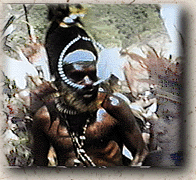 to several provinces that had remote, difficult to develop areas from which there are high rates of outmigration for purposes of finding paid employment. The group I eventually settled on have a typical Melanesian Big Man political system involving competitive feasting and exchange and are especially vulnerable to the impact of urban remittances (money sent home by migrants to fulfill obligations to village kin and to obtain land rights and other desired objects) with the families of the more prosperous migrants obtaining more than their share of land, prestige and marriage partners than households receiving little cash income from urban migrants.
Census reports, local experts, and serendipity:
Picking the actual group I was to work with had to wait until I was in Papua New Guinea and involved reading national and provincial census reports, talking with experts at the University of Papua New Guinea, and a certain amount of serendipity.
Census material is updated every ten years so the census material I relied on in 1982 was fairly recent. Looking over the census material in Papua New Guinea and in Madang Province I saw that the Bundi census division has a high rate of outmigration compared with some areas that have greater local sources of cash income (e.g. cash crops, mining, or other developments).
After deciding on the basis of census material that the Bundi area would be a fitting research locale I was introduced to a History professor at UPNG who was a Gende from Emegari village. August Kituai told me about his people and advised that I do my work in Yandera, the largest Gende village and the host site of an upcoming pig feast which would be attended and partially financed by Gende migrants. As I was enthusiastic, he told me more about Yandera and its leadership, giving me the names of men and women who would assist my studies and ensure my security and well-being while doing the fieldwork. August also introduced me to other Gende living in Port Moresby so that I had many companions and willing informants over the next few days to fill me in on where I was set on going.
Serendipity plays a part in all fieldwork situations. When I first arrived in PNG, I intended working in Morobe Province, dividing my work between Lae (Papua New Guinea's second largest city) and the mountainous Pindiu region. While I received much cooperation from provincial research officers and Pindiu leaders residing or visiting in Lae, I quickly (and innocently) ran afoul of Morobe Province's self-styled leftist prime minister, Utula Samana, who revoked my research permit as a way of highlighting his displeasure with outsiders (especially Americans) in his province. The news hit the world media and I left Morobe Province in a state of shock, wanting only to tuck my tail between my legs and run home.
 The importance of duty calls (and more on serendipity):
One bit of field advice that my friends and advisors offered over and over was : Be polite and introduce yourself and your proposed work to every official, expert, or person you meet from day one in Port Moresby, to the province and beyond. Take no one for granted. This advice turned out to be essential in my case. Before leaving Morobe, I phoned my family, my advisors, and the professors I had met at the University when I went around knocking on their doors, taking a few minutes of their busy time to introduce myself. My family told me that as much as they missed me I should stick it out and try another province. My advisors told me that they believed in me and that if I quit now i would never go back to Papua New Guinea. And all the people I met at the University advised me to return to Port Moresby, rest for a few weeks, and reapply to Madang or some other province, that they had been expecting Samana to do something like this for a long time, and that it was a shame it happened to me. One professor, Louise Morauta, invited me to accompany her family on an Easter trip to Sirinumu Dam (outside Port Moresby), a kindness that renewed my spirit enough to "stick it out". The serendipity in my case was that I changed my research location to Madang Province, met August Kituai (who gave plentiful and good advice), and went on to have many fruitful experiences with a wonderful group of people - the Gende.
Copyright © 1996 by Laura Tamakoshi and Brian Cross