
RAPPORT
The next day:
My first night in the village I drifted in and out of sleep, listening to
distant drumming and the sounds of a flute as men practiced for the
upcoming pig feast, wondering how late the cardgame Elizabeth and Ruge had
deserted me for would last, and feeling like Alice in Wonderland. I awoke
early as Elizabeth rooted around in the patrol boxes looking for something to
make for breakfast and a crowd milled around outside my door. It was time to
begin! After breakfast I stepped forward into the sun, a smile glued on my
face, clipboard and pencil in hand, ready to start. No one was in a hurry to
cooperate, however, being more interested in seeing what kinds of things I
had brought with me and debating over where I should stay and what family
would look after me the best, and so on.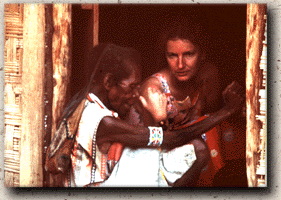 The local catechist, a Yandima clan
member, introduced himself and took me to his half of the village, a crowd of
Yandima people accompanying us. Going from house to house, I made a
rough sketch map of the location of
houses, church and school. Later in the afternoon, I did the same back in
the Tundega clan section of the v
illage. The next day, I went around again - this time with a group of
Tundega children - filling in the names of people living in each house, a
first step in both remembering and recording the five hundred or so people in
Yandera village. Already, most people took my presence for granted, stating
that I was Ruge and Elizabeth's "child" or pikinini bilong tupela
(tok pisin for "that couple's child"). A comforting sentiment but I
worried that if my study was to have merit I must not be too much under the
thumb of one family).
The local catechist, a Yandima clan
member, introduced himself and took me to his half of the village, a crowd of
Yandima people accompanying us. Going from house to house, I made a
rough sketch map of the location of
houses, church and school. Later in the afternoon, I did the same back in
the Tundega clan section of the v
illage. The next day, I went around again - this time with a group of
Tundega children - filling in the names of people living in each house, a
first step in both remembering and recording the five hundred or so people in
Yandera village. Already, most people took my presence for granted, stating
that I was Ruge and Elizabeth's "child" or pikinini bilong tupela
(tok pisin for "that couple's child"). A comforting sentiment but I
worried that if my study was to have merit I must not be too much under the
thumb of one family).
Exchange, gifts, and
friendship:
Remaining neutral was difficult.
Among the 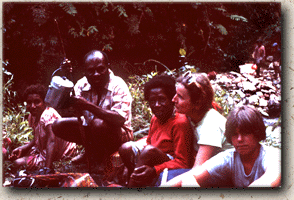 Gende everyone is a member of a clan, related to other Gende through kinship, marriage, and exchange. To be otherwise is to be a stranger. From the moment I met Ruge and Elizabeth on the Bundi airstrip they were making me one of their family, doing things for me and rejecting immediate payment or reciprocity as befits a friendly kin relationship. One of the first things Ruge said to me was that he would look after me while I worked in Yandera, that I would be in "the palm of his hand", and that Elizabeth, the oldest of his three wives, would be my "mother". Being my "parents", Ruge and Elizabeth expected that they would benefit from my fieldwork and that I would support their interests and take their side in village affairs and disputes. I did not always live up to their expectations but we all benefitted from the relationship, I more than they.
Being in their family opened up other, safe relationships for me as "aunt", "sister" or "daughter" to other Tundega clan members and a "mother", "sister-in-law" or "daughter" to clans we were related to by marriage. Over the years, Ruge and his family have been staunch supporters, offering hospitality whenever I returned to Yandera village and tolerating my questions and the special needs of my research. Another close friend was Magdalena, a young woman married into Tundega clan who remained in Yandera that first year long after her husband had left for a town job so that she might be with me.
When I returned to Papua New Guinea in 1986 to teach at UPNG, I made the first of many trips to the town of Goroka to study Gende women in town. My hosts in a Gende squatter settlement on the outskirts of Goroka were Magdalena and Benny, a helicopter mechanic. Whenever I stayed at Okiufa, Magdalena and I went to the stores where I paid for clothes and food that Benny and Magdalena could not afford on his small income as reciprocity for their ongoing assistance. In return, whenever Magdalena met me at the airport, she always brought ice-cold Pepsi, cigarettes, and candy to welcome me with.
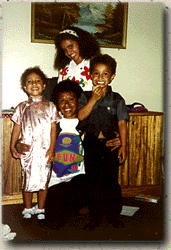 Another woman who was instrumental in my research is Betty Higgins, Ruge and Elizabeth's oldest daughter, a former Air Niugini stewardess and now a big business woman. I met Betty at the end of my first fieldtrip when Elizabeth accompanied me to Port Moresby. Betty introduced me to elite Papua New Guineans who travel the world, lead exciting lives and are at the vanguard of change and yet maintain ties with rural kin and urban kin living less prosperous lives. Over the years, Betty has encouraged me to observe her business enterprises, inviting me to live with her family and seeming to enjoy our friendship with only occasional irritation when I take too many photos when she is hard at work and less than her usual stylish self. When Ruge was killed in a dispute with other Tundega men in 1991, Betty called long-distance to relate the news. When I returned in 1994 to study Betty's Mt Wilhelm farm, I handed her a copy of some of the taped interviews I had made with Ruge. As Betty listened to her father telling stories of his youth, she cried. She is, however, looking forward to receiving a video cassette recording of some of the slides and movies I took back in 1982 and 1983 for her and the children to remember Ruge and others by. In the past I have sent copies of pictures to different Gende informants. By taping some of the ethnographic legacy Ruge and his family and other Gende have helped me collect over the years and sharing it with the younger generation of Gende (and you), I will be fulfilling an obligation to those who helped me.
 The common touch:
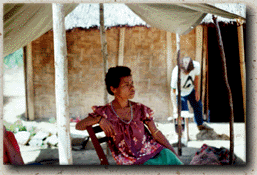
Most Gende are not as open or political as Ruge's family, so many of my friendships with Gende men and women took longer to develop. Usually it was their discovery of our common humanity that brought us closer together and not any special techniques for creating rapport. One incident that brought this fact home was the "mail dispute". In late 1982, after weeks of heavy rain and not receiving mail from Bundi, I was delighted one Sunday to see a man come into the village carrying a bag of mail for me and the school teachers. I hadn't heard from my family (who were back in the United States) for more than six weeks and I wanted to read my mail right away! A school committee member, however, decided that no one would get the mail until Monday morning when the workweek began because it was Sunday, an "official" day of rest, and so the mail would remain in the school "office". As the crowd of Sunday worshippers dispersed to play cards or return to their homes, I sat on the steps of the school office, contemplating the evils of bureaucracy in a distant outpost of the world system. After a time, I stepped into the office and took my mail, returning home to read and reread every letter.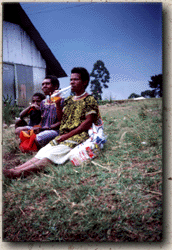 As darkness fell and the card players went home for dinner, a commotion broke out in front of my house as the offended committee member, a friend of mine, shouted how bad I was to break the rules. Disconcerted by a growing crowd of onlookers, I rose to my defense with an emotional outburst of how I missed my children and how unkind he was to withold my mail. People enjoyed our argument, especially when four older women joined in and harangued Joseph over his lack of sympathy for my situation. Standing beside me, they reminded him of how much they missed their own children who were far away in town, and that he should place my feelings ahead of his own desire to act like a "master". Joseph gave up in disgust and we women went inside my house to drink tea and ponder men's ways. Always before these women had snubbed me as cold-hearted; now they saw a more emotional side of me and shared with me their hopes and fears for their children in a world that has changed dramatically since they themselves were young.
Copyright © 1996 by Laura Tamakoshi and Brian Cross